
Blog Details
- Member
- September 23, 2026
Generating New Perspectives
Shailendra Jaiswal
A morphological methodology for perspective generation, and an
invitation to use it
This document sets out a
methodology for generating new perspectives on a problem — deliberately, in a
way that can be taught, repeated, and checked, rather than left to intuition
alone. It emerged from an extended working conversation applying a Srijan Sanchar
framework, AXIM, reflexively to the question of perspective generation itself,
and from tracing that work against the established literature it turns out to
sit inside. It is offered here in that spirit: as something built openly on
real prior work, tested honestly against its gaps, and worth others taking
further.
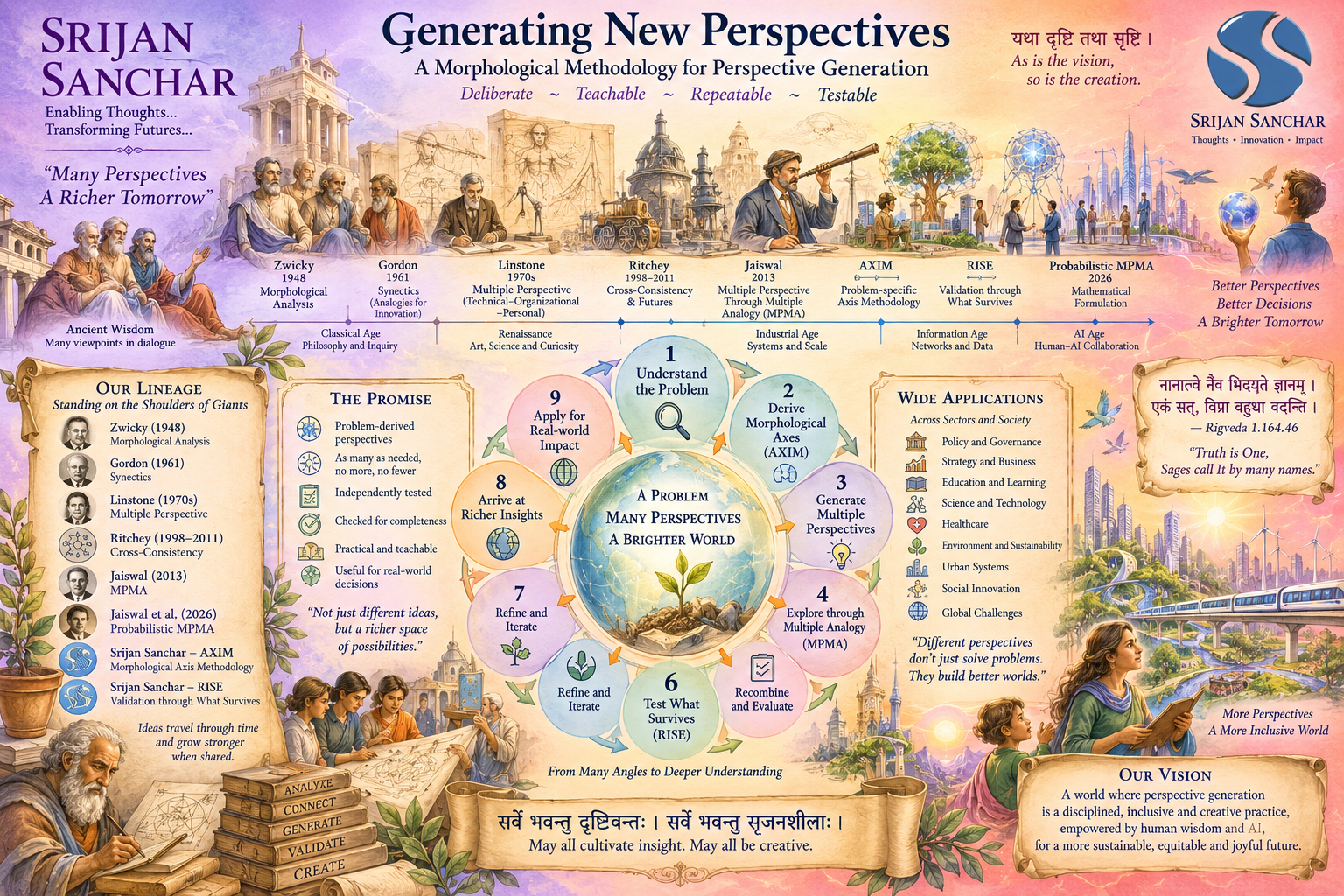
1. Lineage
The methodology does not start
from nothing, and it is more useful for saying so plainly. Two traditions
converge in it.
|
Source |
Contribution |
|
Zwicky, 1948 |
General morphological analysis: decompose a problem into
independent parameters, then systematically recombine their values into a
searchable space of configurations. |
|
Ritchey, 1998–2011 (General Morphological Analysis /
Cross-Consistency Assessment) |
Formalized pairwise compatibility screening of a
morphological box; applied at scale to futures studies and scenario
laboratories. |
|
Linstone, late 1970s onward; Mitroff & Linstone, 1993
("The Unbounded Mind") |
The Multiple Perspective approach: Technical,
Organizational, and Personal lenses on a single problem, applied to real
cases including the Exxon Valdez spill and Bhopal. A fixed three-perspective
set, analysis without a formal recombination step. |
|
Gordon, 1961 (Synectics) |
Facilitated small-group technique generating solutions via
structured direct, personal, symbolic, and fantasy analogies, transferred
back to the original problem. |
|
Jaiswal, 2013 ("Multiple Perspective Through Multiple
Analogy", MPMA) |
A specified source-intermediate-target procedure for group
analogical transfer, run at real scale (over 500 Railways managers, roughly
2,000 students) with named, checkable outputs. |
|
Jaiswal and collaborators, 2026 (Probabilistic MPMA) |
A mathematical reformulation of MPMA using axis
extraction, compatibility tensors, and entropy-based novelty scoring —
procedurally ambitious, not yet demonstrated on a worked case. |
|
Srijan Sanchar, AXIM (Morphological Axis Methodology) |
A five-route protocol (Ontological Decomposition,
Degree-of-Freedom Analysis, Constraint Taxonomy, Stakeholder Value Mapping,
Phase-State Analysis) for deriving and testing independent axes of a
problem-specific design space. |
|
Srijan Sanchar, RISE (Recursive Invariant Synthesis for
Essence) |
A validation layer — Find What Survives, Test Through
Breakdown, the Regeneration Test, stability under perturbation — for checking
whether a candidate structure actually holds, rather than only asserting it. |
The central move of this work is
bringing these two traditions together: applying morphological analysis's
problem-specific, tested axis derivation — historically pointed at product
configurations and future scenarios — to Linstone's target domain, generating
interpretive perspectives on a present problem, which his own three-lens method
never formalized into a combinatorial recombination step.
2. The Promise
Linstone's
Technical–Organizational–Personal lenses and de Bono's Six Thinking Hats both
work by offering a fixed, small set of perspectives, the same regardless of the
problem in front of you. That is their strength and their limit at once:
reliable, teachable, but not shaped by what the specific problem actually
contains.
The promise of this methodology
is a perspective set that is derived from the problem rather than imposed on it
— as many perspectives as the problem's own structure supports, no more and no
fewer, each one independently tested rather than assumed distinct, and the set
as a whole checked for completeness before being used. Where morphological
analysis has mostly generated configurations of things or possible futures,
this points the same disciplined machine at something more immediately useful
in daily reasoning: alternative, defensible ways of seeing what is already in
front of you.
3. Concept and Structure
The methodology runs in five
stages, each doing real work rather than serving as a formality.
3.1 Problem ontology mapping
Before generating any
perspective, the problem itself is decomposed across six categories: its
substance (what object or artifact is involved), its process (what happens or changes),
its relations (how parts and agents interact), its agents (who acts or
decides), its states (what conditions it can be in), and its context (the
environment that makes some framings available and others invisible). This
mapping is what keeps the axes that follow tied to the actual problem, rather
than to a generic checklist.
3.2 Five-route candidate generation
Candidate perspective-generating
axes are drawn from five independent routes: Ontological Decomposition
(structural and functional breakdowns), Degree-of-Freedom Analysis (the
independent variables a designer of the problem could actually set), Constraint
Taxonomy (the physical, logical, social, and resource boundaries the problem
operates within), Stakeholder Value Mapping (where different parties' values
genuinely diverge), and Phase-State Analysis (how the problem's own lifecycle
and transitions behave). Each route tends to surface different axes; where two
routes independently converge on the same one, that axis is treated as more
reliable than an axis only one route found.
3.3 Testing, not accepting
Every candidate axis is tested
before being kept. Independence: does varying this axis actually produce a
different outcome than varying another? Non-redundancy: is this really a
distinct dimension, or the same one under a different name? Actionability: is
this a genuine choice available to someone designing a perspective, or a
downstream consequence that should be treated as context instead? In practice
this step does real pruning — in the worked run of this methodology against the
general space of perspective-generation techniques, roughly a dozen initial
candidates collapsed and were reclassified down to eleven surviving,
independently tested axes, spanning five axis types (configurational, parametric,
modal, relational, normative):
|
Axis |
Type |
Range |
|
Source multiplicity |
Configurational |
Single-domain — multi-domain |
|
Transformation operator |
Configurational |
Positional / rotational / inversional / scalar / spectral
/ temporal / relational / … |
|
Representational medium |
Configurational |
Linguistic / formal-mathematical / sensory-instrumental /
institutional / cultural |
|
Structural fidelity |
Parametric |
Metaphorical — formally isomorphic |
|
Directionality |
Modal |
Permanent departure — round-trip return |
|
Tether strength |
Parametric |
Loose — tightly bound to target constraints |
|
Protocol intensity |
Modal |
Lightweight heuristic — structured multi-session protocol |
|
Novelty–actionability orientation |
Normative |
Surprisal-optimized — yield-optimized |
|
Generation cardinality |
Relational |
Solo — group-facilitated |
|
Iteration structure |
Modal |
Single-pass — cyclical/recursive |
|
Observer position |
Relational (single-route) |
External/analytic — reflexive/participatory |
3.4 Completeness checks
Two tests confirm the axis set
is doing real work. A coverage test maps known, independently recognizable
techniques or framings onto the space to check they land at genuinely different
coordinates — if they collapse onto the same point, the axes are not
discriminating enough. A surprise test deliberately samples unusual corners of
the space — combinations of axis values not obviously drawn from an existing
example — to check whether they correspond to real, occupied, or at least
plausible configurations, rather than nonsense.
3.5 Generation by sampling
Once the axis set is tested,
generating new perspectives becomes a matter of sampling specific corners of
the space — deliberately choosing a combination of axis values and working out
what perspective that combination actually describes — rather than
free-associating. This is where a genuinely useful finding emerged from the
work: several of the axis-discovery routes themselves, run in reverse, function
as generation operators rather than analysis tools. Constraint Taxonomy run
forward finds constraints; run backward, it forces a concrete answer to
"what does this look like with one specific constraint removed."
Stakeholder Value Mapping run forward finds where values diverge; run backward,
it forces the whole problem to be redesigned around one specific stakeholder's
values alone. This reversal is not currently described in any of the source
literature reviewed and may be a genuine addition in its own right, worth
testing further rather than assumed.
4. Possibilities
●
Problem framing and reframing, where a fixed three- or
six-perspective checklist is too coarse for the problem's actual structure, and
a bespoke, tested set of perspectives is worth the extra derivation effort.
●
Creative problem solving and structured ideation, where
the axis-reversal generation operators offer a repeatable alternative to
unstructured brainstorming.
●
Organizational strategy and scenario-adjacent work,
extending Ritchey's own established use of morphological analysis in futures
studies from generating multiple possible futures to generating multiple
present interpretations of the same situation.
●
Teaching and facilitation, since the method's stages —
decompose, generate, test, sample — are explicit enough to be run by a group
without requiring an expert's tacit judgment at every step, in the spirit of
Linstone's and Gordon's own facilitated formats.
5. Challenges
These are stated plainly because
a methodology asking to be adopted by others should be judged on its actual
limits, not a flattering account of itself.
●
Nothing generated through this methodology so far has
been run through a validation layer like RISE's Find What Survives, Test
Through Breakdown, or Regeneration Test. Every perspective produced to date is
an untested candidate, not a demonstrated one.
●
A direct honest audit of one batch of ten sampled
perspectives found that four were reconstructions of already-named techniques
(pre-mortem analysis, autoethnography, TRIZ-style reversal, the extreme-user
method), one was a known weakness in experimental design rather than a genuine
technique, and only three to four were assessed as real departures from
existing practice. The yield of genuinely new perspectives per sampling run
should be expected to be modest, not comprehensive.
●
No worked application of this specific methodology
exists yet at the scale or with the rigor of Jaiswal's 2013 MPMA trial —
several hundred participants, a real institutional problem, named and checkable
outputs. Everything produced so far has been reasoned through by a small number
of people in a single extended session.
●
The axis-reversal generation operators are a promising
finding but were noticed incidentally rather than deliberately designed and
tested; only four of the five routes have been tried in reverse, and the fifth
(Ontological Decomposition, reversed) remains untried.
●
Some candidate axes remain unresolved rather than
cleanly settled — for instance, whether two axes describing when and how a
perspective shift is triggered are truly independent or are the same dimension
viewed from two directions.
6. Road Ahead
●
Run RISE's validation steps against a real batch of
generated perspectives, to separate genuine restructurings from elaborations
that only feel novel.
●
Run the methodology once, properly, against a real
problem with a real group — the way Jaiswal ran MPMA against Railways
challenges and Linstone ran the Multiple Perspective approach against the Exxon
Valdez spill — and compare the perspectives it produces against what an
unstructured session produces on the same problem.
●
Test the fifth route, Ontological Decomposition, in
reverse, to complete the picture of which axis-discovery routes double as
generation operators and which do not.
●
Position the methodology explicitly against its own
lineage in any future write-up — Zwicky and Ritchey's morphological analysis,
Linstone and Mitroff's Multiple Perspective approach, Gordon's Synectics —
rather than presenting it as free-standing, since its actual contribution is
the specific combination of these, not an unrelated invention.
●
Build a light, repeatable template — a problem ontology
map, a route-by-route candidate log, an orthogonality test record, and an axis
card format — so the methodology can be picked up and run by someone who was
not part of its original development.
This
document sets out a method, not a finished result. Its honest state, as of this
writing, is a tested structure with promising early findings and no validated
output yet — worth using, and worth checking rigorously as it is used.